Solar battery storage for home solar panels.
Bring the power of the sun into your home, day and night.

What is a solar battery?
Solar batteries are just big ol’ rechargeable batteries for your home. They charge up during the day using your excess solar power (if you’re producing any). And because they’re connected up to your home, you can use the stored electricity when your solar panels aren’t making enough. That includes after dark, when you usually wouldn’t be getting any benefit from solar!
You can choose to add a solar battery to your choice of our solar panel installation packages, or we can integrate them into your existing solar panel system.
To help you get started, our team of solar and battery storage experts have put together this handy guide to choosing the right power storage solution for your needs.
Get up to £200 off new solar panels and batteries.
If you're an E.ON Next customer you can save £200 when purchasing solar panels and a battery system by using code SOLAR200, or save £150 when you purchase a solar panel system only, using code SOLAR150. T&Cs apply.
Top benefits of solar battery storage.
Energy independence.
Become a strong, independent solar household. With solar battery storage, you can be less reliant on the grid - improving your energy security. Generating and storing your own electricity means you won’t be as affected by price changes in the energy market.
Cost savings.
Harnessing the sun's energy and storing it for later use can lead to cost savings in the long run. A 12 panel solar system, battery and SEG tariff from us could see savings of up to £1,207 a year1. T&Cs apply."
Environmental benefits.
Solar panels are a renewable, low carbon source of electricity - helping you to reduce the carbon footprint of your home energy. In fact, the average home would save around a tonne of carbon every year by installing solar panels2 (exact savings vary by location).
Why choose battery storage from E.ON Next?
1Exclusive solar tariffs.
E.ON Next solar customers are eligible for our exclusive SEG tariffs. Add a battery to your solar package to unlock our top export rates.
20% APR* finance available.
Enjoy the convenience of spreading the cost of your solar system with our 0% APR finance options for up to 3 years.
3A trusted provider.
All our solar packages come with MCS accredited installation as standard.
4Peace of mind.
Your investment is protected with our 10 year warranty on battery storage products.
I already have solar panels. Can I still add a solar battery?
Absolutely! When adding a solar battery to existing solar panels, you’ll need to have separate batteries and photovoltaic inverters installed. This is because the battery must be connected on the AC (alternating current) side of the solar panel’s inverters - meaning it won’t pass through them. You may see this being called “AC connected” or “AC coupled”.
Your home uses AC electricity to power everything from your lights to your microwave. So, it’s important an inverter is added to your new battery system to change your battery power into usable electricity.
What does a solar inverter do?
The main purpose of a solar inverter is to change the DC electricity generated by your solar panels into the AC electricity used in your home. It will ensure your solar power current is synchronised with the grid. Many modern inverters also have useful monitoring features to help you understand how your panels are performing.
Solar inverters aren’t the same as charge controllers. A charge controller manages where your electricity goes, such as directing it into your solar battery. They are connected between your panels and your battery. Every solar battery installation should come with a charge controller, whether you are adding the battery to an existing solar installation or at the same time.
Can I add more storage to an existing solar battery system?
It may be possible to expand your current storage capacity by adding additional batteries to the system. However, it will depend on the manufacturer of your current battery storage.
The cost of solar batteries.
If you're having solar panels installed by us, you can add solar battery storage to your system for as little as £1,900.
Don't wait any longer, join the renewable energy revolution and secure your energy independence now. Simply request your free solar battery quote and take the first step towards a more sustainable future.

How solar batteries work.
Solar panel batteries store the surplus energy produced during the day and release it for use when the sun is not shining. There are two main battery technologies currently used: lithium-ion and lead-acid. Both types are designed to handle the cyclic charging and discharging necessary for solar energy storage.
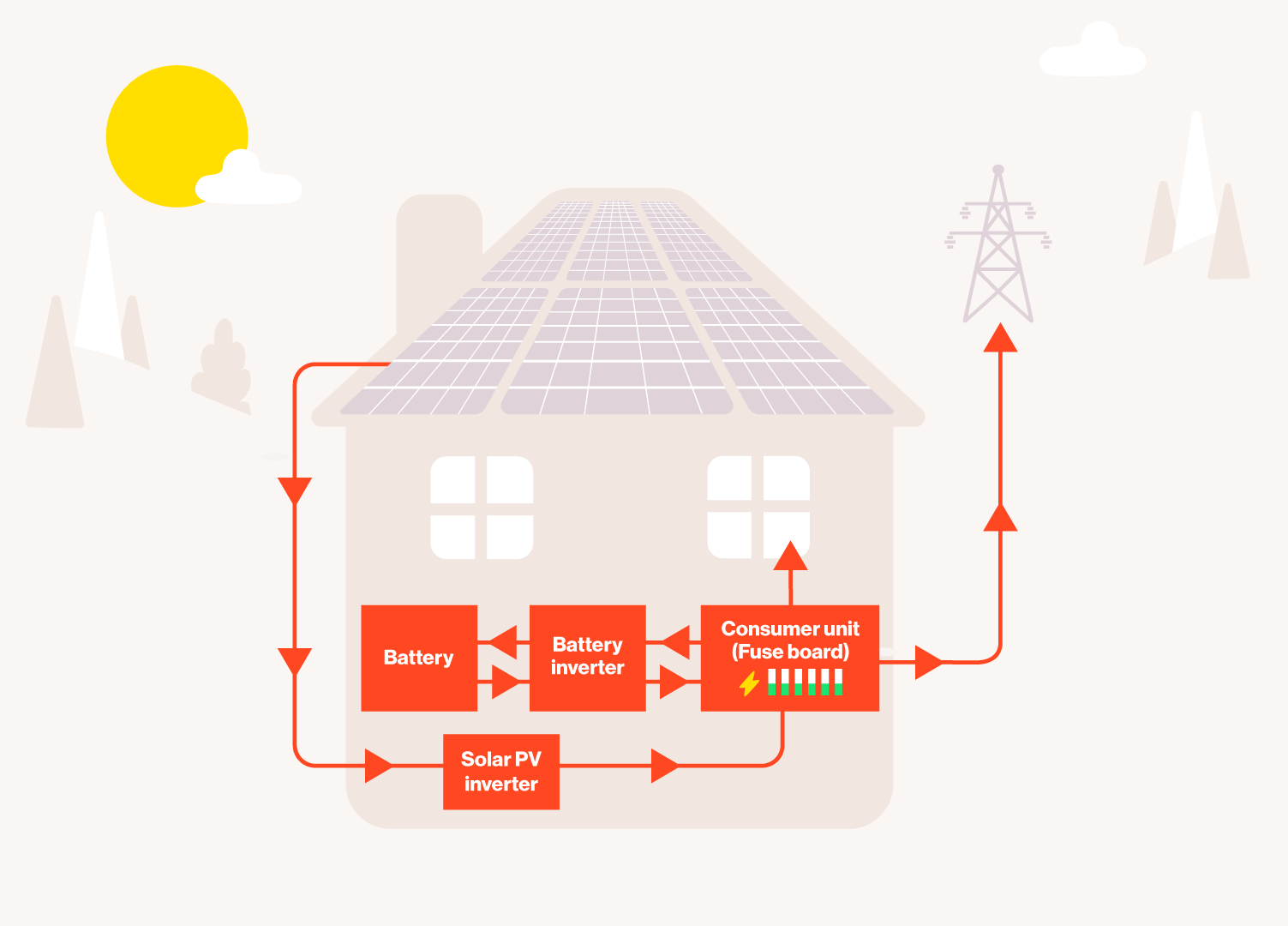
When sunlight hits a solar panel, the solar cells convert it into direct current (DC) electricity. The DC electricity flows to the inverter, where it is converted into alternating current (AC) suitable for powering household appliances and devices. If the electricity demand in your home is lower than what the solar panels generate, the excess DC electricity can be diverted to charge the battery.
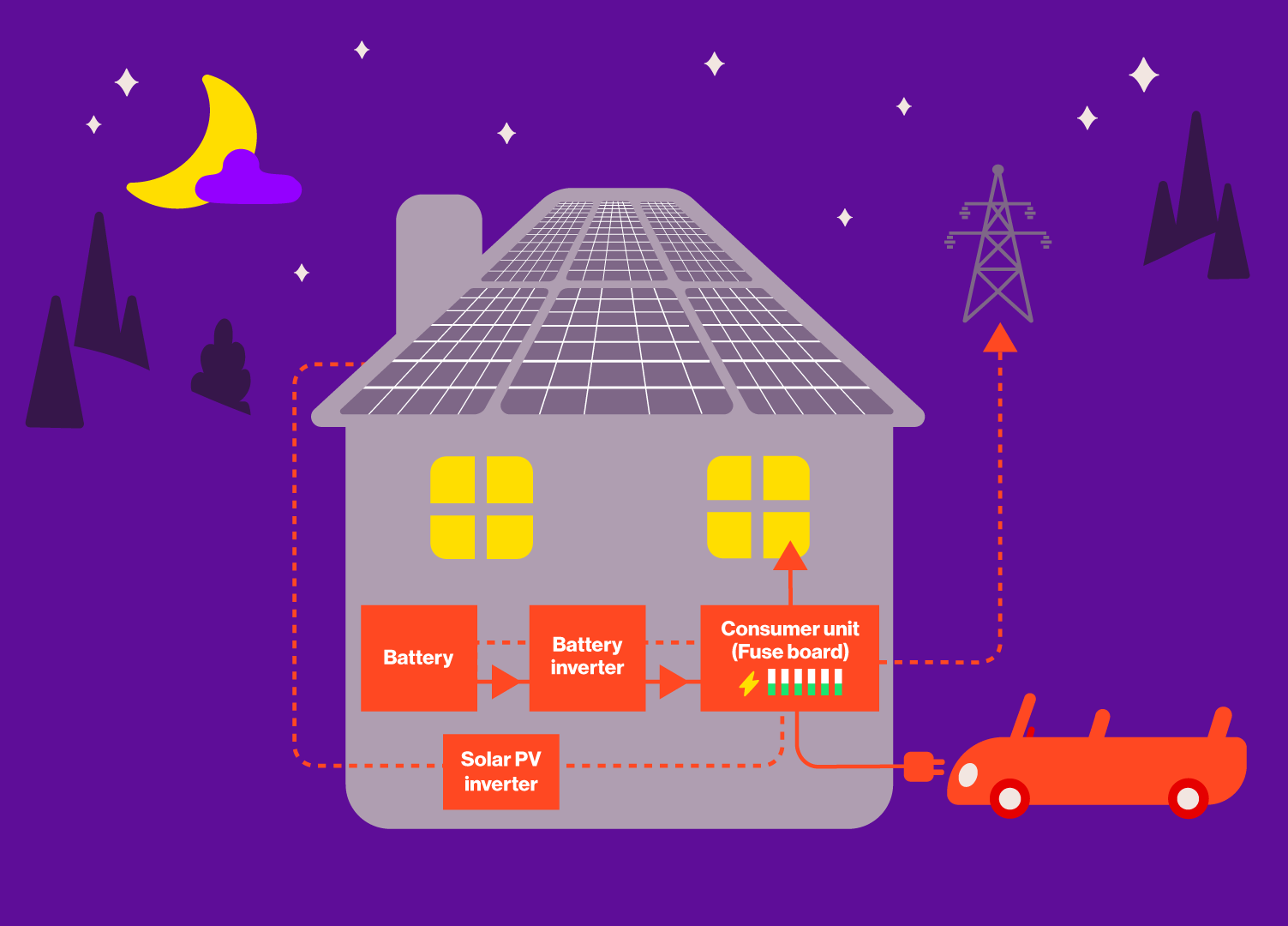
During the night, when your home requires electricity, the solar battery discharges its stored energy to power your appliances and devices, allowing you to benefit from solar power even after sunset.
Types of solar batteries.
There are four different types of batteries that are currently used for solar battery storage. Although, they’re not all available (or suitable) for home use.
Lead-acid batteries.
The original rechargeable batteries. They’re often cheaper than similar alternatives, but have a shorter lifespan and low energy density (meaning they can store less power for their size). Suitable for smaller solar setups with less excess power.
Lithium-ion batteries.
A more recent rechargeable battery tech with improved energy density and efficiency. Their higher upfront costs are offset significantly by their longer lifespan, making them a popular choice. Suitable for all home solar systems (and most commercial).
Flow batteries.
Flow batteries store energy by moving liquid electrolytes between two tanks to cause chemical reactions. They’re highly energy efficient but have low energy density, so they need a lot of space. They’re a good choice for large scale solar projects, but not suitable for homes.
Nickel-cadmium batteries.
A battery tech with unique properties. Nickel-cadmium batteries can withstand high temperatures and are very durable, making them ideal for certain industrial uses. They’re not used in homes as they’re components are toxic and difficult to dispose of properly.
Could a solar battery be right for you?
How big is your solar panel system?
Larger solar installations will generate more electricity, meaning you should have more excess to store. If you don’t generate much excess power a solar battery may not be the best investment.
When do you use your energy?
Solar panels generate power during the day, meaning you’ll get the most use out of your batteries after dark. If you mainly use electricity during the day, a solar battery may not add as much benefit for you.
Do you have a SEG tariff?
You can have both a solar battery and a SEG tariff, however you will need to prioritise which one your excess energy goes towards. If you can earn more per kWh from your SEG tariff than you pay for your electricity, then a solar battery is unlikely to save you money.
How much does a solar battery cost?
Already getting solar panels installed with us? Add a solar battery to your installation from just £1,900.
We have a range of different sized batteries to suit your installation - simply let us know how much storage capacity you need.
Do I have to pay VAT on solar panels and solar batteries?
Since February 2024, standalone battery installations have qualified for the zero rate of VAT. This is in addition to solar batteries installed as part of a solar panel installation, which already qualified for zero VAT.
Are there any solar grants or schemes available?
Yes, there are! The Energy Company Obligation (ECO) scheme provides funding to Britain’s most vulnerable households for energy-efficient home improvements, including solar panels and batteries. To be eligible your home must have an EPC rating of D or below, and you must also meet one of the following criteria:
Receive one or more means tested benefits.
In receipt of child benefit (income thresholds apply).
Qualify under a Local Authority of supplier flex declaration.
If you think you could be eligible you can apply for energy efficiency funding online.
Not eligible for ECO4? While there aren’t currently any other government grants to help cover the costs of solar installation, you can still benefit from the Smart Export Guarantee (SEG). The Smart Export Guarantee ensures you get paid for the excess solar power you generate and export back to the grid. Helping you earn a little extra back for the solar energy you don’t use. We have a range of great SEG tariffs available, so check ‘em out.
Explore the power of commercial solar battery storage.
Discover reliable and efficient commercial solar batteries for your business or commercial needs. Explore our selection of high-performance solar storage solutions designed to boost energy efficiency and reduce costs.

Frequently asked questions about solar batteries.
What are solar batteries made of?
Our solar batteries use lithium iron phosphate (LFP), the safest type of lithium-ion chemistry commonly available. That means they have a reduced risk of thermal runaway compared to other lithium-ion batteries.
LFP batteries have longer lifespans and improved efficiency compared to their alternative, lead-acid batteries.
How big are solar batteries?
Solar batteries and inverters can vary in size, depending on the power and size of the battery. Typically they need around 1 meter width and 1.3 to 1.9 meter height in wall space.
Where will the solar battery be installed?
The solar battery will be installed in a suitable location based on a full survey of your home. It needs to be installed close to your main consumer unit. Typically we suggest installing in places like a cupboard, garage, or utility room.
Can solar panels work without battery storage?
Yes, your solar panels will still generate electricity for your home without battery storage. Any excess power they produce will be exported back to the grid. You can get paid for your energy exports through the Smart Export Guarantee.
What's the lifespan of a solar battery?
The average lifespan of a solar battery is around ten years, but it will vary depending on the type of battery, usage, and maintenance. To help protect your investment, all our battery systems come with a 10-year manufacturer's warranty.
Can I have a solar battery outside?
Yes, you can have a solar battery installed outside, but it should be wall-mounted on a sheltered wall, away from direct midday sun and rain.
Will my solar battery still work if there's a power cut?
Our range of solar batteries all have an "Emergency Power Supply" (EPS) function, however it requires complex electrical work to set up that is not included in your E.ON installation.
You can hire local electricians after the solar panel installation to set up the EPS. They will need to reconfigure your home’s electrics and supply earthing (usually one or more earth rods fixed into the ground near your property).
Once installed, the battery system can operate in "island mode" during power outages, supplying electricity whilst it recharges from your solar panels.
What is the 'depth of discharge' and 'usable capacity'?
Depth of discharge (DoD). The percentage of the battery’s total storage capacity that can be safely discharged at once. Lithium-ion batteries have a maximum depth of discharge of around 80%. Going beyond the maximum depth of discharge (also called deep discharge) could harm the lifespan of the battery.
Usable capacity. The amount of power (measured in kWh) that a fully charged battery will allow you to draw before the battery management system kicks in. The battery management system prevents too much power being drawn (deep discharge) or put into (over-charge) the battery. This helps protect the lifespan of the battery.
It may be possible to programme your battery management system to kick in at a lower percentage, which will further increase the lifespan of your battery - but reduce the usable capacity.
In practice, the electricity available for use in your home is typically about 95% of the usable capacity due to small efficiency losses during charging and discharging.
Will my SEG tariff change if I add a solar battery?
Your SEG tariff shouldn’t be affected by installing a solar battery, so you can continue to export excess solar power to the grid for SEG payments. However, if you choose to use your battery to store some or all of your excess solar power, your SEG payments will be significantly lower or may stop altogether. You only get paid for the power you export to the grid.
Depending on your export rates, storing your excess power in a battery for later use may be more cost efficient than the SEG payments you receive. By using more of your own solar power, you will need to use less electricity from the grid and so your electricity bills will be lower.
If your current export rate is higher than the price you pay per unit for your electricity, then you will likely see greater savings by continuing to maximise your SEG payments.
Can I install a solar battery myself?
Solar battery installation can be hazardous and should always be carried out by a certified electrician. If not properly installed, lithium-ion batteries are at risk of thermal runaways which cause the battery to run at extremely high temperatures that can result in permanent damage to the battery and even fire.
All our solar batteries come with professional installation from E.ON as standard, along with a 10 year manufacturer’s warranty.
How much electricity can a solar battery store?
It depends on the size of your battery. Our lithium-ion solar batteries range from 2.6 kWh of storage all the way up to a generous 9.5 kWh.
Remember, that your solar batteries are for short term energy storage. You will usually use most of the energy you store the same day once it gets dark.
According to the UK’s Typical Domestic Consumption Values (TDCVs), the average household uses 3,900 kWh per year. That averages around 10.7 kWh per day. (Your actual daily usage will vary throughout the year.) So, 9.5 kWh is more than enough stored energy to get most households through the night - with some spare for a rainy day.
Just remember, you need to be generating enough excess solar power to fill your battery to get full use of its capacity! Size isn’t everything, pick the right solar battery to meet the needs of your home.
The legal bit.
1 Figures are based on standard MCS calculations for a south-facing 12-panel solar array in central England, on a 35-degree tilt roof, with no shading, and annual electricity usage of 4,000 kWh. The tariff rate is 26.11p/kWh (Ofgem Energy Price Cap from 1st July 2026). Savings assume a 5.1 kWh battery (usable capacity 4.6 kWh) and Smart Export Guarantee (SEG) payments of 17.5p/kWh under E.ON Next Premium v3. Actual savings may vary. Our experts may suggest additional or alternative products, updating savings based on your specific situation. Geographical and eligibility restrictions apply.
2 https://energysavingtrust.org.uk/advice/solar-panels/
* E.ON Energy Installation Services Limited is a credit broker not a lender and work exclusively with HomeServe Finance Limited who acts as the lender under Firm Reference Number 994955. Any credit is subject to status, affordability and a credit check; HomeServe Finance Limited terms and conditions apply.
E.ON Next Energy Limited is an Introducer Appointed Representative of E.ON Energy Installation Services Limited and is authorised and regulated by the Financial Conduct Authority under Firm Reference Number 973651.
Zuno Partners Limited is an Appointed Representative of E.ON Energy Installation Services Limited and is authorised and regulated by the Financial Conduct Authority under Firm Reference Number 1043798.
E.ON Energy Installation Services Limited is authorised and regulated by the Financial Conduct Authority for credit broking services under Firm Reference Number 750410. Registered in England and Wales under company number 09965944 at Trinity House, 2 Burton Street, Nottingham, NG1 4BX.