zappi vs. Ohme: Choosing the right EV charger for your home.
Author: E.ON Next
Reading Time: 6 mins
Are you entering the EV world but feeling unsure about which bit of kit to choose for your driveway? Selecting a home charger can be a big decision. However, it’s not as complicated as you might think.
Whether you’re eyeing up the myenergi zappi GLO or considering the Ohme Home Pro and ePod, both brands are market leaders for a reason, but they excel in slightly different areas.
Whether the Ohme or zappi is better for you is all about lifestyle fit. The zappi is a connectivity and solar powerhouse, while Ohme specialises in automation with a minimalist look.
To find your perfect match, you really only need to think about three things:
Your home connectivity (WiFi vs. 4G).
Your energy sources (e.g. solar panels).
How you like to manage your tech (through a screen or an app).
Let’s explore your EV charger options.
Will an Ohme or zappi charger work with my electric vehicle (EV)?
It’s a common worry for new EV owners, but it doesn’t have to be. All the chargers in our range use the universal Type 2 connector. This has become the standard for virtually every EV sold in the UK and Europe.
Whether you drive a Kia EV6, an Audi Q4 e-tron, or a Tesla Model 3, these chargers are fully compatible. Thanks to the universal Type 2 connector, you can plug in with peace of mind, regardless of your car’s battery size.
Learn more about choosing and installing a home EV charger.
Ohme Home Pro vs. ePod: Which one should you choose?
If you’ve decided on an Ohme charger, you’ve got two possible options that focus on different priorities. Let’s check out each design.
What are the benefits of the Ohme Home Pro charger?
The Ohme Home Pro is a flagship model for drivers who want more of an interactive experience. It features a built-in LCD screen directly on the unit, so you can check your charging status or start a session without reaching for your phone.
It also comes with a 5m tethered cable, meaning it’s always attached and ready to plug straight in.
What are the benefits of the Ohme ePod charger?
If you prefer a neater look for your driveway, the Ohme ePod might be the best option. It’s extra compact and uses an untethered (socketed) design.
This means you use your car’s own cable, which you can tidy away in the boot or garage when it’s not in use. It’s a great choice for those who value a sleek, minimalist look.
Should I choose the Ohme charger?
The biggest draw for Ohme is automation. Ohme chargers are specialists in smart tariffs — aka ‘tariff native’ tech.
Weighing up zappi chargers: The zappi GLO benefits.
The zappi GLO could be a good choice if you’re looking for technical flexibility and reliability.
Reliable connectivity.
Connectivity is where zappi can really shine. While Ohme relies on a built-in 4G SIM, the zappi GLO offers WiFi, Bluetooth, and a physical Ethernet port – talk about options!
If you live in an area with patchy mobile signal or your charger is installed far from the house, the physical Ethernet connection solves any signal drop out issues.
Should I choose a zappi charger?
As we’ve mentioned, Ohme is great for automation, but zappi wins on hardware flexibility. For starters, the zappi GLO comes with a 6.5m tethered cable as standard — a full 1.5m longer than the standard Ohme Home Pro cable.
That extra reach can be a lifesaver if your charging port is on the furthest away side of the car or you park further from the wallbox. Plus, it has an IP65 storm-proof rating.
Reliability and control: The zappi vs. Ohme app experience.
When it comes to EV chargers, the app is your window into your charging habits, and both brands handle things slightly differently.
zappi vs. Ohme: Smart features compared.
The Ohme app is built for simplicity and cost capping. It’s designed to make sure you never pay more than you have to by automatically scheduling your charge around your tariff’s cheapest hours.
On the other hand, the myenergi app for zappi gives you deep visibility into your entire home’s energy flow. If you like data and want to see exactly where every watt of power is going, the zappi experience could be your best bet.
Avoiding connectivity issues.
We've all heard the stories of chargers that forget to charge. Often, this comes down to a connectivity clash. Choosing a 4G only charger like an Ohme works well if you have a good mobile signal in your drive.
However, if your driveway struggles to get a 4G signal, WiFi or Ethernet connected zappi give you the potential for a less patchy connection.
Solar EV charging: Is zappi or Ohme better for solar panels?
If you have solar panels (or plan to get them), this part’s for you! Maximising your self generated energy is the zappi charger’s superpower.
zappi’s Eco+ mode.
The zappi GLO is well known for its Eco+ mode. It can sense exactly when your home is producing surplus solar power that would otherwise be sent back to the grid. Instead of letting that energy go, Eco+ diverts all of it into your EV.
It essentially lets you charge your car using nothing but UK sunshine!
Ohme’s Solar Boost.
Ohme chargers also support solar charging through its ‘Solar Boost’ feature, but it’s generally considered a bit more basic than zappi’s native ecosystem.
The verdict.
Ohme’s biggest strength remains grid-tariff optimisation, but it’s zappi that was built from the ground up to be part of a wider solar home.
zappi vs. Ohme: Key features compared.
Need to check out the zappi and Ohme charger key features at a glance? This handy table gives you the lowdown.
Feature | Ohme ePod | Ohme Home Pro | zappi GLO |
|---|---|---|---|
Suitability | Tidy driveways (if you want a discreet look and don't mind plugging in your own cable) | Easy control (if you want to start a charge using a screen rather than your phone) | Solar and WiFi stability (ideal for solar panel owners and homes with weaker mobile signal) |
The set up | Untethered (socket) | Tethered (fixed) | Tethered (fixed) |
Cable length | N/A (use your own cable) | 5m (an 8m option is available) | 6.5m (offers extra reach for awkward parking spots) |
Internet options | 4G SIM | 4G SIM | WiFi and ethernet |
How to use | App only | LCD screen or app | App and RFID |
Unlocking Next Drive Smart.
You could help lower charging costs if you pair your new EV charger with a smart tariff. Many of our chargers, including zappi, integrate with our Next Drive Smart tariff. However, for the moment, our Ohme models aren’t compatible.
The 8p/kWh advantage.
By using the E.ON Next Home app to manage your charger, you can unlock an ultra-low off-peak rate of just 8p per kWh for your whole home between midnight and 6am. That’s our cheapest rate for powering your electric journey.1
The multiplier effect.
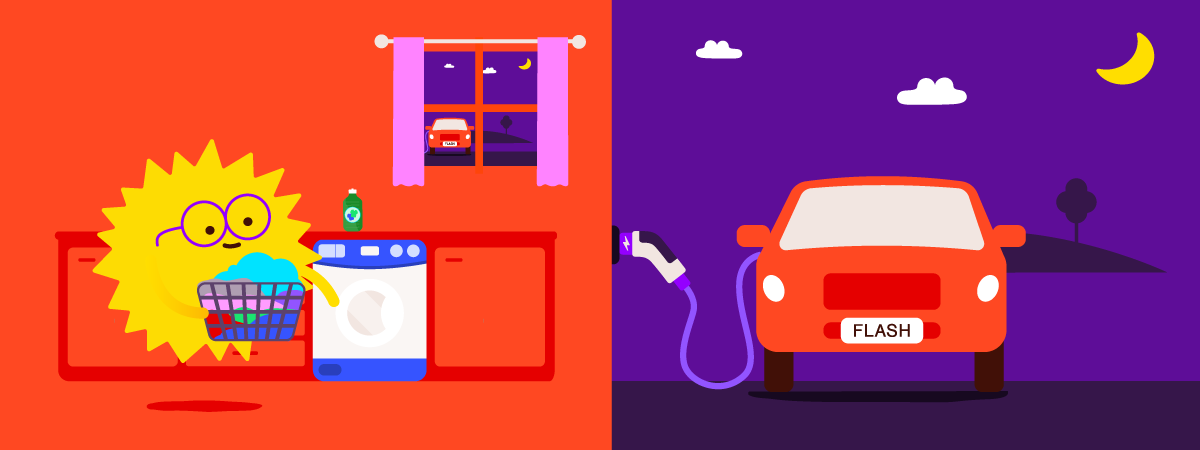
Here’s the clever bit. When the app schedules a ‘Smart’ charge for your car during the day, that cheaper 8p rate doesn't just apply to your car, it applies to your whole home during the smart charging window.
That means you could save money on your laundry, dishwashing, and vacuuming at the same time your car is powering up. Plus, you can see these slots in the app in advance.
Ready to find your EV charger match?
Whether you want the solar savvy zappi GLO or the automation expert Ohme range, we can help you get installed and onto the Next Drive Smart tariff. Explore our home chargers.
- 1. Off-peak rates on the Next Drive Smart tariff are fixed at 8p/kWh between 12am-6am daily, applying to EV charging and whole home electricity use. Smart meter with half hourly consent required. You must have an eligible electric vehicle and charger. If you do not boost charge, you will always be charged at off-peak rate of 8p/kWh. Any boost charges or charging without using the smart charging feature during peak hours will be billed at the peak rate of 27.456p/kWh. Information correct at 27 May 2026. Terms and conditions apply.
Published: 02/06/2026
Updated: 02/06/2026
Related Blogs

The real barriers and benefits of going electric. Insights from 5,000 UK electric vehicle drivers.
What's really stopping people from switching to electric vehicles? To find out, E.ON Next surveyed nearly 5,000 UK drivers. Read on to get the full lowdown.

Next Optimise explained: We answer your top five solar and battery questions.
We answer the top questions about Next Optimise: how it works, battery wear, power loss, and why automated management. Read on to find out more.
Next Drive Smart: Save on home and EV charging.
Discover how the Next Drive Smart tariff offers some of the UK’s lowest off-peak rates, automated smart charging, and whole-home energy savings.

Next Smart Saver: the tariff that could help you save on your energy bills.
The energy landscape has shifted. Our Next Smart Saver tariff could help you save energy and reduce costs around the home. Read on to find out more.

What is automated energy trading? A beginner's guide to Next Optimise.
If you've got solar panels and a home battery, you've already done something most people haven't. You've taken control of where your energy comes from. Learn about automated energy trading with Next Optimise.
Related Blogs
The real barriers and benefits of going electric. Insights from 5,000 UK electric vehicle drivers.
What's really stopping people from switching to electric vehicles? To find out, E.ON Next surveyed nearly 5,000 UK drivers. Read on to get the full lowdown.
Next Optimise explained: We answer your top five solar and battery questions.
We answer the top questions about Next Optimise: how it works, battery wear, power loss, and why automated management. Read on to find out more.
Next Drive Smart: Save on home and EV charging.
Discover how the Next Drive Smart tariff offers some of the UK’s lowest off-peak rates, automated smart charging, and whole-home energy savings.
Next Smart Saver: the tariff that could help you save on your energy bills.
The energy landscape has shifted. Our Next Smart Saver tariff could help you save energy and reduce costs around the home. Read on to find out more.
What is automated energy trading? A beginner's guide to Next Optimise.
If you've got solar panels and a home battery, you've already done something most people haven't. You've taken control of where your energy comes from. Learn about automated energy trading with Next Optimise.
Recent Blogs

How half hourly settlement changed the energy market (and why it matters for your home).
Discover how mandatory half-hourly settlement is revolutionising the UK energy market. Learn how this change enables Next Optimise to automatically trade your solar battery for maximum savings.

When is the cheapest time to use your washing machine?
Want to cut down on your electricity bill? Learn the best off-peak times to run your washing machine and save on utility expenses effortlessly.

Is my home ready for Next Optimise?
This guide walks through what you need, what to check, and what to do before you get started with Next Optimise.