How to reduce gas bills: Moving from savings to independence
Author: E.ON Next
Reading Time: 6 mins
Key takeaways:
Prioritise heating efficiency: Heating accounts for 80% of gas usage; focus improvements here rather than on minor habits.
Switch to heat pumps: While gas costs less per unit, heat pumps are 3–4x more efficient, offering better long-term value.
Execute quick wins: Lower boiler flow to 60°C, bleed radiators, and draught-proof your home for immediate savings.
Generate your own power: Solar panels and battery storage reduce grid reliance and protect against market price shifts.
Use smart tariffs: Pair solar and storage with dynamic or time-of-use tariffs to maximise value and minimise dependence.
Achieve transformation: Combining a heat pump, solar, and battery can cut grid reliance by 70%, effectively replacing gas usage.
The 2026 energy market is still a bit of an unpredictable beast. Whether it’s global supply shifts or local pricing tweaks, many of us still feel a familiar pinch when the monthly statement lands in our inbox. It’s completely easy to see why you might search for ways to save on gas bills or reduce gas bills. We all want that immediate relief.
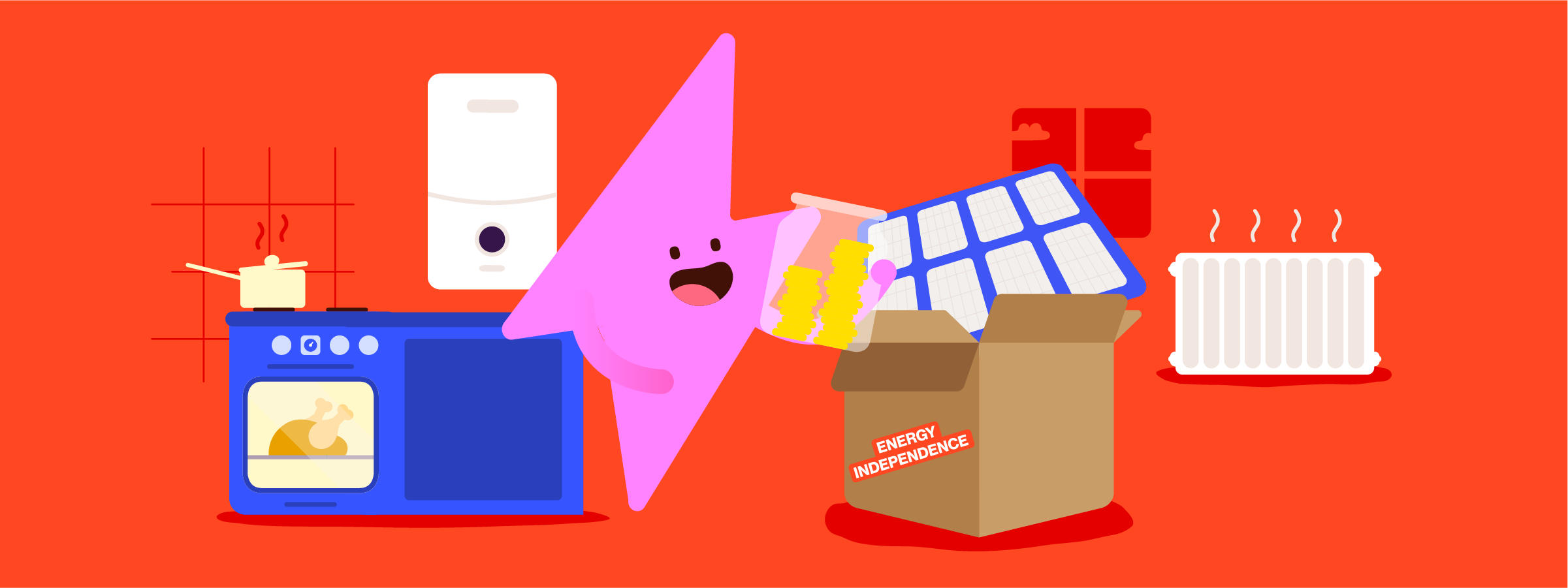
However, there’s a bigger picture to look at. While small habit changes are great, the most effective way to truly protect yourself from market price jumps is to look at your reliance on gas altogether. It’s about moving from just managing the cost to gaining genuine energy independence.
If you're curious about where your current costs stand, this gas guide is a great place to start for understanding current tariffs.
What uses the most gas in my house?
Before you can tackle the bill, you need to know where the energy is actually going. For the vast majority of UK homes, the breakdown is fairly consistent:
Heating (80%): The biggest portion of your gas goes toward keeping your rooms warm.
Hot water (15%): Showers, baths, and taps make up the second largest chunk.
Cooking (5%): Gas hobs and ovens actually use a tiny amount compared to your boiler.
Understanding this helps you prioritise. While turning off a gas ring a minute early is a good habit, it won't have the same impact as making your heating system work better.
Is electricity cheaper than gas?
This is a question many people ask when looking at how to reduce gas bill costs. If you look at the price per unit (kWh), gas is technically cheaper than electricity. However, that’s only half the story.
Traditional gas boilers are rarely 100% efficient. In contrast, electric heat pumps are incredibly efficient, often three to four times more efficient than a boiler. This means they turn one unit of energy into three or four units of heat. When you pair that efficiency with solar panels and home battery, the total cost of running your home can drop. This often makes electricity the smarter financial choice for the long term.
Quick wins: How to reduce your gas bill today.
If you're looking for immediate UK energy bills saving tips, you don't always need to spend a lot of money. There are several quick wins that can help you save on gas bills starting this week.
The 60 degree challenge.
Most condensing boilers are set to a flow temperature that’s actually too high to run efficiently. By lowering your boiler flow temperature to 60°C, you can save roughly 12% on your gas usage. The best part is that your rooms will still stay just as warm, as the boiler just works a bit more intelligently.
Radiator care and TRVs.
Air trapped in your radiators makes your boiler work harder than it needs to. Bleeding your radiators regularly ensures they heat up fully. It is also important to make sure you're using your thermostatic radiator valves (TRVs). There’s no point heating a spare bedroom or a storage cupboard to the same level as your lounge.
The draught audit.
Draught-proofing is one of the cheapest and most effective ways to reduce gas bills. Whether it’s a professional service or a DIY job with some foam strips, sealing gaps around doors, windows, and even letterboxes keeps the heat you’ve paid for inside where it belongs.
The standby myth: Can you reduce home heat with appliances off?
There’s a common mix-up when people search for how to reduce home heat with appliances off. While it’s a great idea to turn off electronics on standby to save on your electricity bill, it doesn't actually reduce your gas heating usage. Your TV or toaster doesn't have a direct link to your boiler.
However, looking at your home this way is still useful. Reducing electrical waste is often the first step toward a whole-home energy strategy. When you start thinking about every watt of energy, you’re better prepared for the move to a more sustainable, electric-led home.
The power shift: Swapping gas for self-sufficiency.
This is where we move from small savings to a total transformation. The old way of managing energy is reactive, where you buy gas from the grid and hope the price doesn’t go up. The new way is proactive, where you generate your own power right on your roof.
Solar and battery logic.
By installing solar panels and a solar battery, you can store the energy you generate during the day to use at night. This allows you to stay ahead by using your own free energy during peak times when grid prices are highest. It’s a big part of reducing your reliance on external gas supplies.
The role of heat pumps.
To truly reduce gas bills, a heat pump is the final piece of the puzzle. By swapping a gas boiler for an air source heat pump, you reduce your gas consumption significantly. Because these systems run on electricity, your solar panels can help power your heating, making you much more self-sufficient.
The grid connection and SEG.
Don't forget that being independent doesn't mean being disconnected. Through the Smart Export Guarantee (SEG), you can actually export any extra energy your solar panels generate back to the grid for a credit on your bill. It turns your home from an energy consumer into an energy producer.
Taking control of your energy with a time of use tariff.
While the Smart Export Guarantee helps you earn from what you don’t use, switching to an intelligent tariff lets you maximise savings on the power you do consume, especially if you have solar panels, a home battery, or a heat pump.
Next Smart Saver acts as a flexible time-of-use tariff, allowing you to charge your battery or run your heat pump during off-peak hours when rates are significantly cheaper.
Next Optimise takes things a step further as a dynamic tariff. It turns your solar and battery into an intelligent energy partner by automatically managing when to import, store, or export power based on real-time prices.
By making your energy work harder, these tariffs help you squeeze even more value out of your tech setup and speed up your journey toward complete independence from the gas grid.
The average household transformation.
To see how this works in the real world, let’s look at a typical three-bed semi-detached house in the UK.
Metric | Typical gas setup (Sep 2026) | The solar and heat pump transformation |
Gas usage | ~11,500 kWh | £0 (Gas line removed) |
Electricity usage | ~2,700 kWh | Usage rises, but grid reliance drops by 70% |
Annual cost | ~£1,663 (Price cap) | Significantly reduced or offset by solar |
By switching to an electric heat pump powered by a solar and battery system, that gas bill effectively disappears. Even though you'll use more electricity to run the heat pump, a well-sized solar and storage setup can reduce your reliance on the grid for that electricity by up to 70%. This is the cheapest way to heat a home in the UK in 2026 because it protects you from the highs and lows of the global gas market.
Find the right solution for your home with our energy saving offers
Published: 04/09/2026
Updated: 04/09/2026
Related Blogs

How to transform your property into a modern eco home?
Learn how you can turn your home into a sustainable eco house. Our blog offers insights for families seeking eco-friendly and energy efficient home tech.

How to find the best energy plan for your home in 2026
Ready to switch? Discover how to find the best energy plan for your home, lock in 12-18 month certainty, and outsmart the April 2026 Price Cap changes.
Can your energy tariff help to lower your winter bills?
Explore winter energy tariffs that match your lifestyle and budget. Discover a range of E.ON Next energy tariffs to lower your energy costs in 2025

E.ON Next confirms it will pass on savings from VAT cut to customers.
Following the Government’s decision to remove VAT from electricity bills from 1 October, E.ON Next has confirmed it will pass on every penny of savings to its customers.

Energy prices are rising, should I fix my tariff?
Fixed tariffs are back on the menu at E.ON Next so, are you better off fixing your tariff now or staying on the standard variable tariff, as the prices are rising to £1,723 from October 2026?
Related Blogs
How to transform your property into a modern eco home?
Learn how you can turn your home into a sustainable eco house. Our blog offers insights for families seeking eco-friendly and energy efficient home tech.
How to find the best energy plan for your home in 2026
Ready to switch? Discover how to find the best energy plan for your home, lock in 12-18 month certainty, and outsmart the April 2026 Price Cap changes.
Can your energy tariff help to lower your winter bills?
Explore winter energy tariffs that match your lifestyle and budget. Discover a range of E.ON Next energy tariffs to lower your energy costs in 2025
E.ON Next confirms it will pass on savings from VAT cut to customers.
Following the Government’s decision to remove VAT from electricity bills from 1 October, E.ON Next has confirmed it will pass on every penny of savings to its customers.
Energy prices are rising, should I fix my tariff?
Fixed tariffs are back on the menu at E.ON Next so, are you better off fixing your tariff now or staying on the standard variable tariff, as the prices are rising to £1,723 from October 2026?
Recent Blogs
Compare electric vehicle tariffs: Next Drive Fixed vs Next Drive Smart.
Compare E.ON Next EV tariffs. Discover whether Next Drive Fixed (set timer) or Next Drive Smart (lowest off-peak rate + app automation) fits your home.
How to transform your property into a modern eco home?
Learn how you can turn your home into a sustainable eco house. Our blog offers insights for families seeking eco-friendly and energy efficient home tech.

E.ON completes acquisition of OVO.
No immediate change for customers of either business, with all tariffs and customer service channels unchanged.